
What is virtual reality training?
Virtual reality training uses immersive VR technologies to simulate real-world environments and tasks in a controlled, digital setting. Trainees wear virtual (VR) or mixed reality (MR) headsets to engage with lifelike scenarios that mirror real-life situations, from flying helicopters to performing medical procedures, without risk or physical constraints. This approach enables safe, repeatable, and highly realistic practice that prepares learners more effectively than traditional methods alone.
In the context of enterprise and governmental use, such as with Varjo’s high-resolution virtual and mixed reality solutions, VR training is designed to replicate exact operational conditions, meaning that training feels and behaves as authentically as possible. This is especially important for reducing negative training.
How to Create Virtual Reality Training
Creating VR training involves several core steps:
-
Define training objectives: What specifc skills, tasks or scenarios will trainees need to practice for? What is the desired outcome of the training? Setting objectives early on will help you to succeed in setting up a succesfull VR training program.
- Map your use case: Consider things such as what you want trainees to do in the training scenario, do they need to collaborate with each other, move around, do they need to use their hands in the scenario? These questions help you in defining the right capabilities you need from the technology you choose.
- Choose the right technology: Use headsets and platforms that support the visual quality, performance, and compatibility your training and use case require. Think of what software you need support for, as that is crucial for the headset you choose. What level of visual quality and fidelity do you need? Photorealistic or will a lower resolution work for your use case? How well do you need, for example, colors to match the real world? If photorealism is important, choosing a device that enables that will help you achieve your goals. For a more detailed checklist for choosing the right technology, read more here.
-
Develop virtual content: Designers and developers build or integrate 3D environments and interactive scenarios using tools like Unity, Unreal Engine, or specialized simulation software. Find out more from our Developer Portal.
- Integrate hardware and software: Connect headsets with simulation platforms, motion platforms, and tracking systems to support immersion and functional interactivity.
- Test and iterate: Pilot the VR training with a small group, analyze performance and user feedback, then refine visuals, interactions, and assessment elements.
For organizations building research or academic VR labs, dedicated guides, such as Varjo’s step-by-step VR/XR lab setup documentation, help streamline technology adoption.
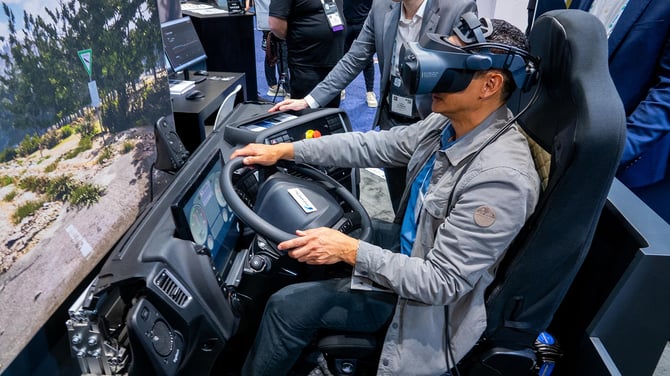
For use cases where the trainees need to see their hands, mixed reality is the best choice, as demonstrated above.
How to Use Virtual Reality for Training
To use VR for training effectively:
-
Prepare the environment
Set up VR hardware (headsets, tracking sensors, compatible computers) and ensure software is installed and calibrated.
-
Introduce trainees to the system
Provide orientation on how to wear the headset, navigate VR controls, and interact within the simulation.
-
Run training sessions
Trainees enter fully immersive VR scenarios that represent realistic tasks, from tactical defense exercises and flight simulators to medical procedures and industrial operations.
-
Monitor and assess performance
Use tools like integrated eye tracking, motion capture, and performance analytics to measure trainee actions, decision-making, and response times. This data offers insights into skill development and gaps.
-
Repeat and refine
VR training supports unlimited repetitions, letting learners practice until competence is achieved, even for difficult, infrequent, or dangerous scenarios.
Virtual and mixed reality simulator training with integrated eye tracking allows the instructor to review the trainee’s real-time performance in a highly accurate way. Read more from our case study with MVRsimulation.
What Are the Benefits of Virtual Reality Training?
Virtual reality training delivers quantifiable benefits across various use cases.
Faster Learning
In a study by Embry-Riddle University, adding VR to the flight training curriculum cuts the time to first solo flight by around 30%. Similarly, the U.S. Air Force found that following VR adoption, students reached solo about 10 flights earlier than the old approach with traditional classroom methods.
Safe, repeatable practice
Learners can rehearse critical tasks, including emergency procedures and complex decision-making, without risk to people or equipment. A PwC study found that learners were 4 times faster to master skills and 275% more confident in using them and more engaged than in classroom learning.
Cost and scalability advantages
Immersive training can dramatically cut costs vs. physical simulators or on-the-job training while enabling hundreds or thousands of training hours on demand.
Greater accessibility
VR allows training at the point of need, whether it’s for a distributed team or remote locations, without travel constraints or physical facility limits. Read for example our customer story about Kia, and how they were able to remotely collaborate on design, eliminating the need for design management to fly to Korea to discuss model designs.
Measurable performance insights
With features like eye tracking and integrated analytics, organizations can track proficiency, retention, and areas for improvement objectively.
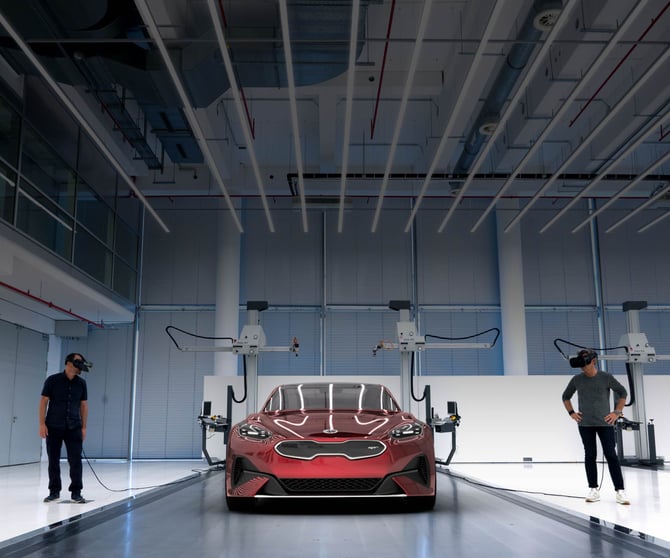 In VR training and industrial use cases, such as design, the ability to remotely collaborate saves time, money and increases accessibility.
How to Enhance Training with Virtual Reality
Here’s how organizations can boost the impact of their VR training programs:
Use mixed reality
Combine physical tools and virtual elements to bridge hands-on practice with immersive learning. In mixed reality, virtual objects appear as part of the real world, making the experience feel natural and realistic. In training, this allows, for example, pilots to interact with real, physical flight instruments while flying in a fully virtual environment.
Integrate motion platforms
Pair VR headsets with motion systems to simulate real movement and physical feedback, increasing immersion and reducing simulator sickness.
Tailor scenarios to roles
Develop custom scenarios that map directly to job tasks, mission requirements, or certification standards.
Add performance analytics
Use built-in tracking and external data collection to measure outcomes, tailor feedback, and support adaptive learning.
Blend with traditional methods
VR is most effective when integrated with instructor-led sessions, real-world practice, and debriefings that reinforce lessons learned.
Motion platforms simulate real movement in mixed reality training, as demonstrated by BRUNNER's NOVASIM MR DA42 simulator
Conclusion
Virtual reality training enables immersive, repeatable, and measurable learning experiences that closely mirror real-world conditions. By reducing risk, improving engagement, and supporting scalable deployment, VR has become a powerful tool for modern training programs.
As VR technology continues to evolve, virtual reality training will play an increasingly important role in helping organizations train more effectively, safely, and efficiently across industries.
Read more:
- Case Studies: read how other industries are using VR to train, design and research
- Why do I need a powerful computer to use VR/XR?
- How to create VR/XR content?
- System requirements for Varjo XR-4 Series
- What is PCVR, standalone device, and wireless VR headset?
- Get to know VR/XR terminology